Research is one of the most rewarding parts of my work. I publish on responsible AI, Agile and enterprise transformation, and the evolving relationship between people and technology — drawing on the lessons that emerge from my real engagements. Below are my latest publications.
Responsible AI Innovation for Social Impact: A Case Study in Multilingual Media Moderation
Co-authored with the United Nations International Computing Centre and New York University School of Professional Studies
Published September 2025
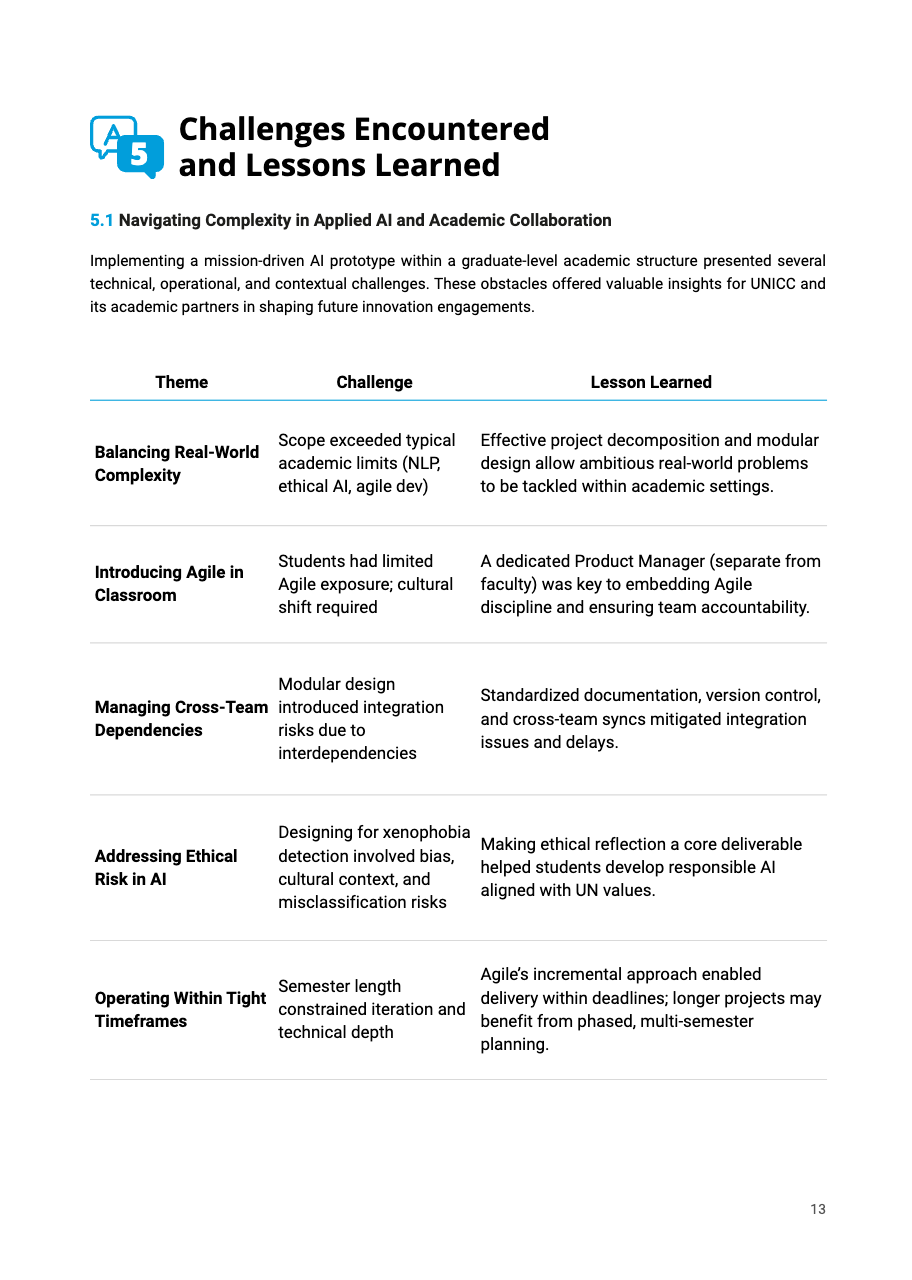
Most organizations talk about responsible AI. But transformation and adoption still require structured execution, ethical governance, and a growth mindset to make it work.
In collaboration with the United Nations International Computing Centre and New York University, I co-authored this research and led the AI program management for a platform designed to detect misinformation and harmful narratives for vulnerable populations across six languages and three media formats: text, audio, and video. Sixteen teams.
The project integrated content moderation, sentiment analysis, fact-checking, and multimodal AI processing, combining responsible AI principles with real-world product development and cross-functional collaboration.
The platform was recognized by UNICC for its potential to support UN digital priorities in media governance and human rights monitoring
Transforming decision sciences education through AI and Agile: A case study of project-based learning in technology management
Co-authored with Dr. Andrés Fortino, New York University School of Professional Studies
Published September 2026 in the Decision Sciences Journal of Innovative Education
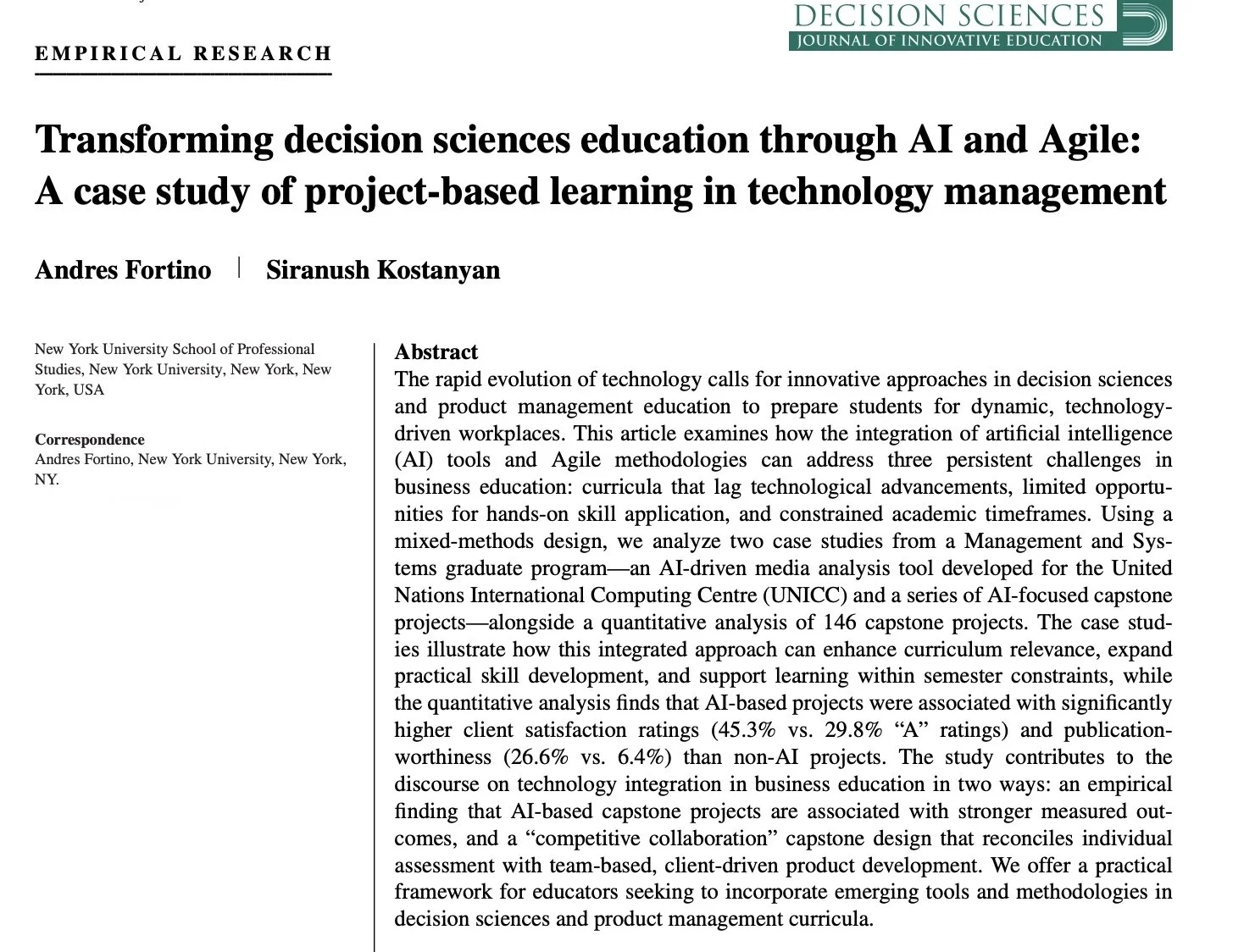
As artificial intelligence rapidly changes the workplace, education faces a challenge: how do we prepare students for technologies and ways of working that are evolving faster than traditional curricula?
This research examines how AI, Agile methodologies, and project-based learning can be integrated into graduate technology management education to create more practical, relevant, and industry-connected learning experiences. The study combines two case studies with an analysis of 146 graduate capstone projects.
The findings showed that AI-based projects were associated with stronger measured outcomes: 45.3% received “A” client satisfaction ratings compared with 29.8% of non-AI projects, and 26.6% were considered publication-worthy compared with 6.4% of non-AI projects.
The research also introduces a “competitive collaboration” model designed to combine individual accountability with team-based, client-driven product development.
Integrating AI and Agile in STEM Education: A Case Study of Project-Based Learning in Technology Management
Co-authored with New York University School of Professional Studies
Published October 2024
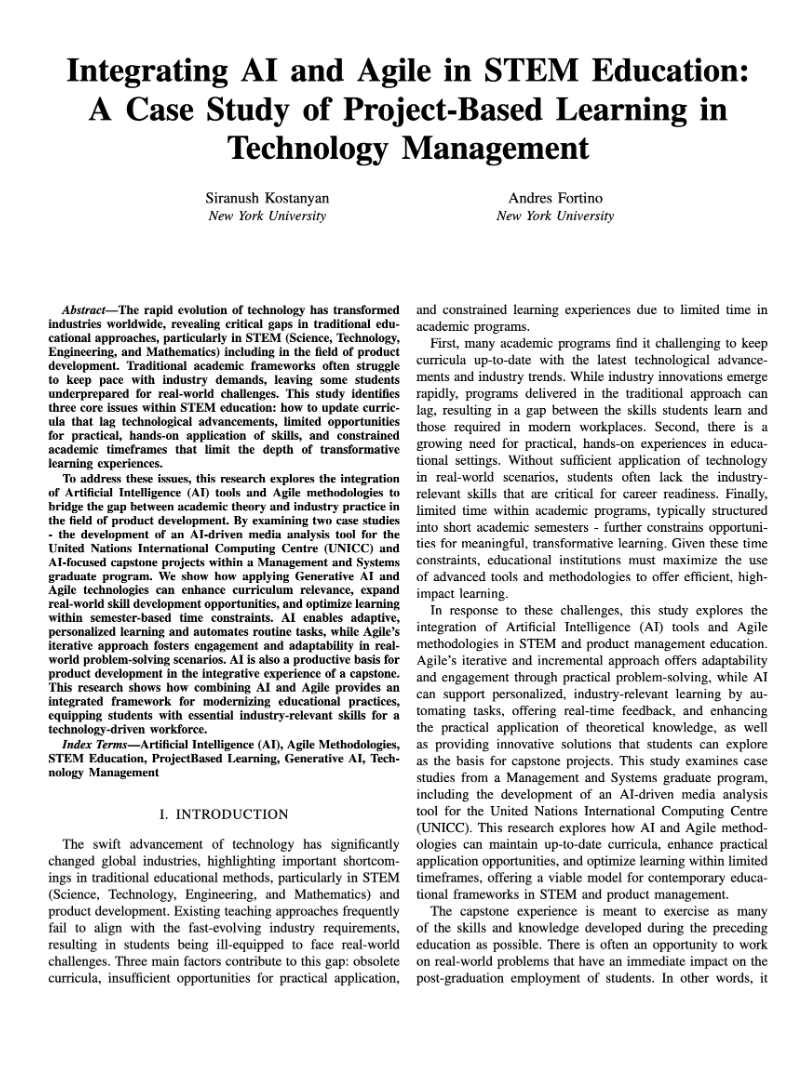
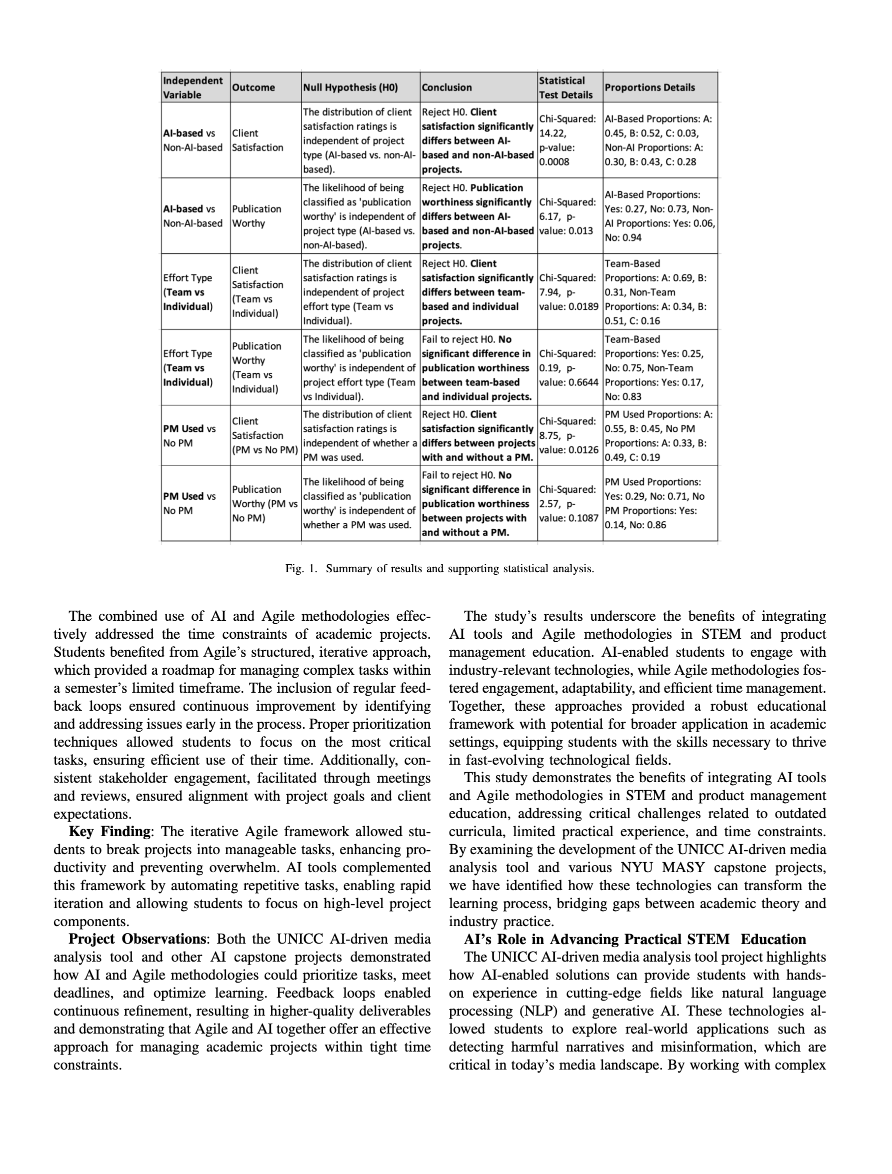
The rapid evolution of technology has transformed industries worldwide, revealing critical gaps in traditional educational approaches, particularly in STEM (Science, Technology, Engineering, and Mathematics), including in the field of product development. Traditional academic frameworks often struggle to keep pace with industry demands, leaving some students underprepared for real-world challenges.
This study identifies three core issues within STEM education: how to update curricula that lag technological advancements, limited opportunities for practical, hands-on application of skills, and constrained academic timeframes that limit the depth of transform
Navigating Ethical Challenges in Media:
AI Tools for Detecting Harmful Narratives
Co-authored with New York University School of Professional Studies
Published February 2026
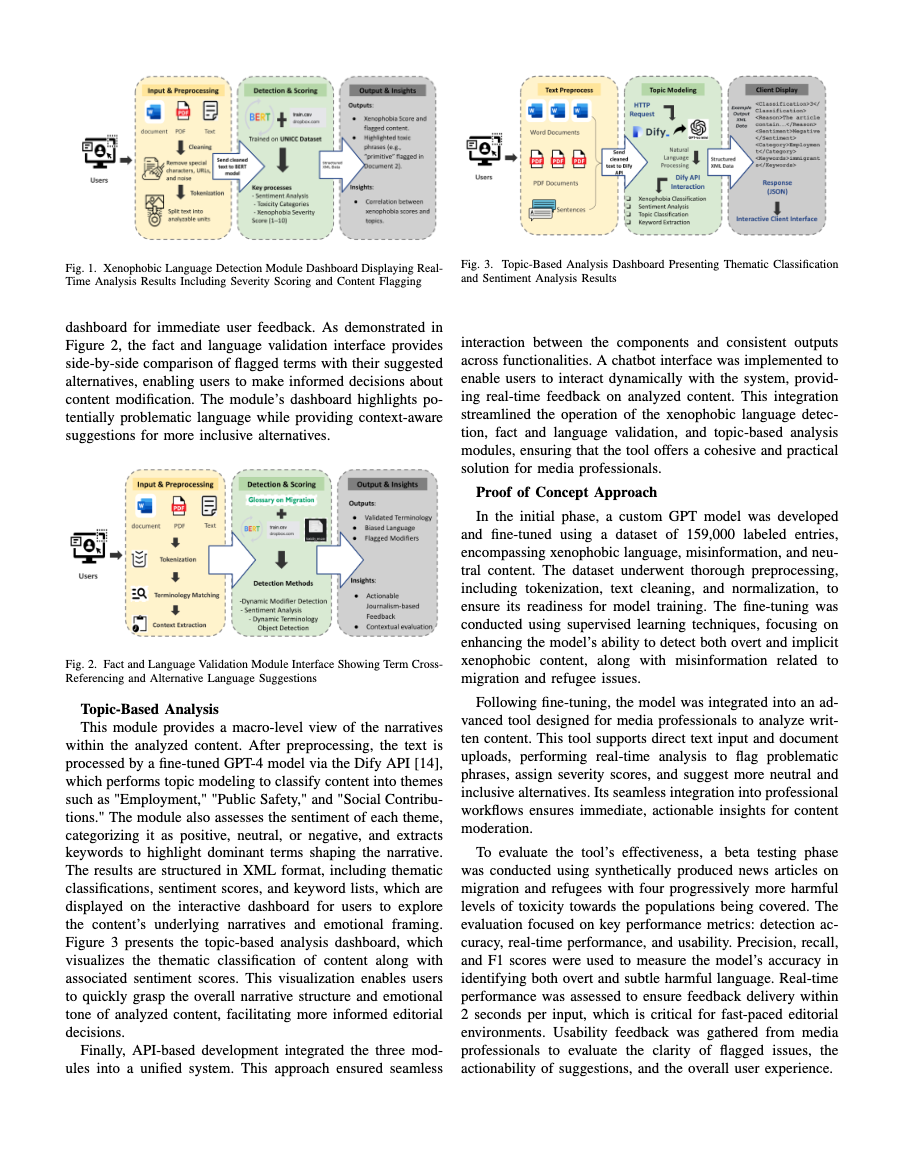
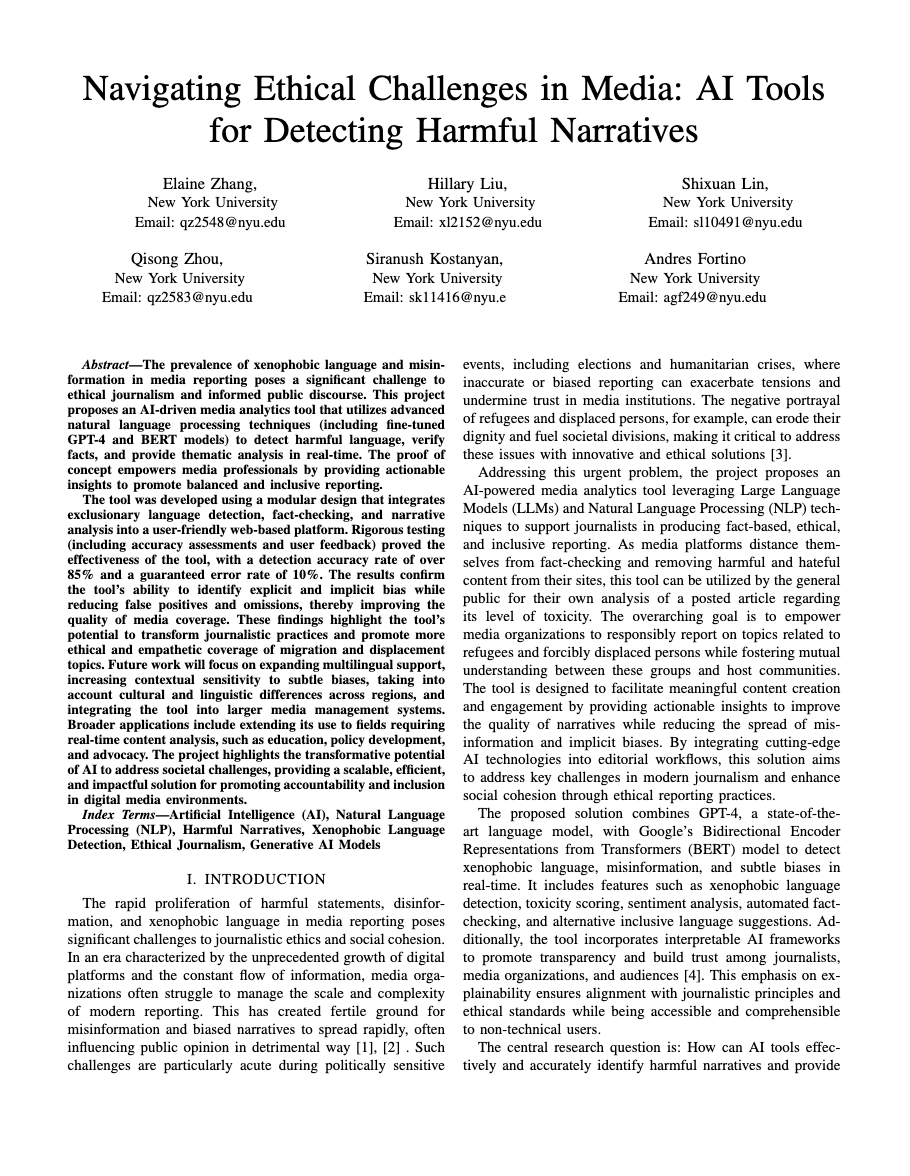
This research explores how Artificial Intelligence can be used to identify xenophobia, misinformation, and harmful narratives in digital media environments. The project introduced an AI-driven media analytics platform that combines natural language processing, fact-checking, and narrative analysis to support more balanced and inclusive reporting.
Built using fine-tuned GPT-4 and BERT-based models, the solution was designed as a modular, real-time system capable of detecting both explicit and subtle forms of bias while reducing false positives. Testing demonstrated over 85% detection accuracy, highlighting the potential of AI to improve accountability and ethical standards in media practices.
The project demonstrates how responsible AI can move beyond theory into scalable solutions with applications across journalism, education, policy, and advocacy.
MIRROR: A Multimodal AI Framework for Detecting Xenophobia and Misinformation in Digital Media
Co-authored with New York University School of Professional Studies
Published March 2026
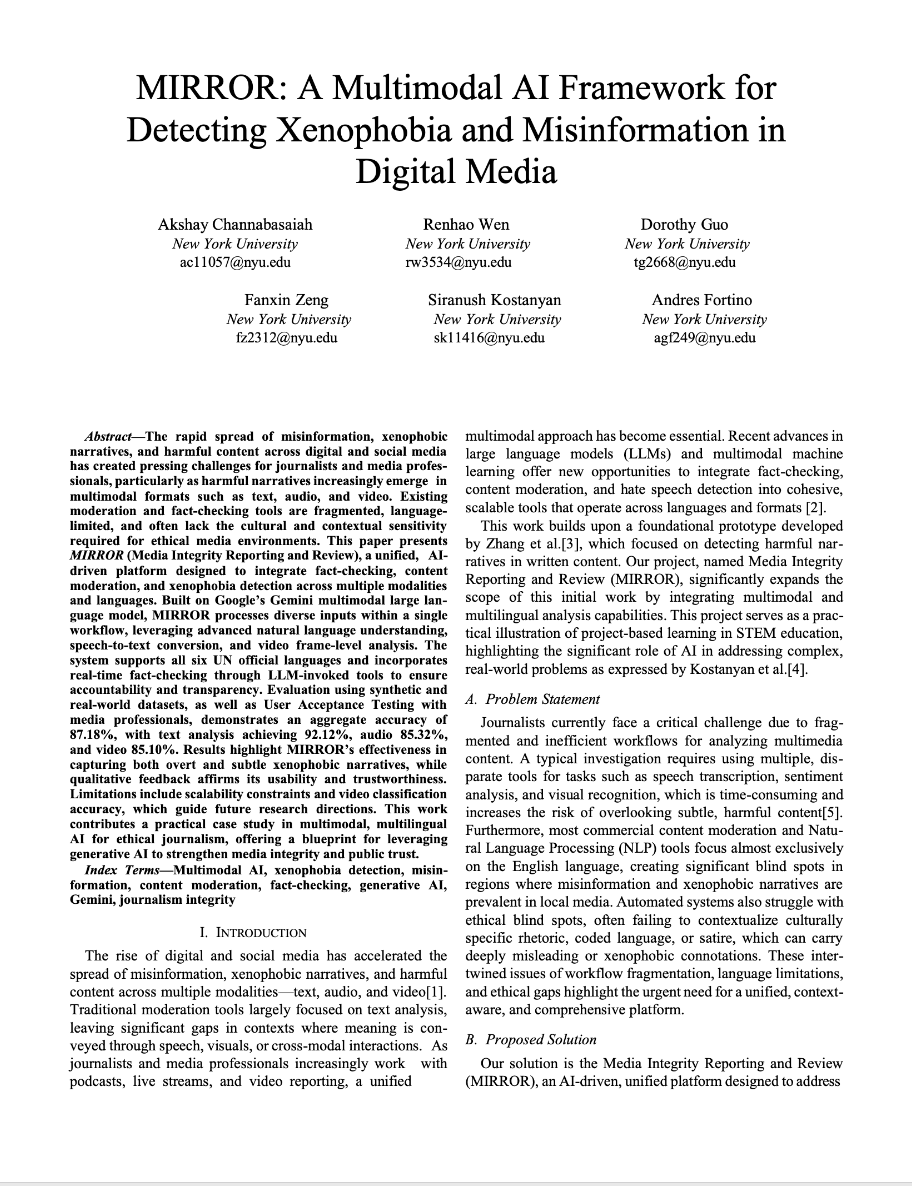
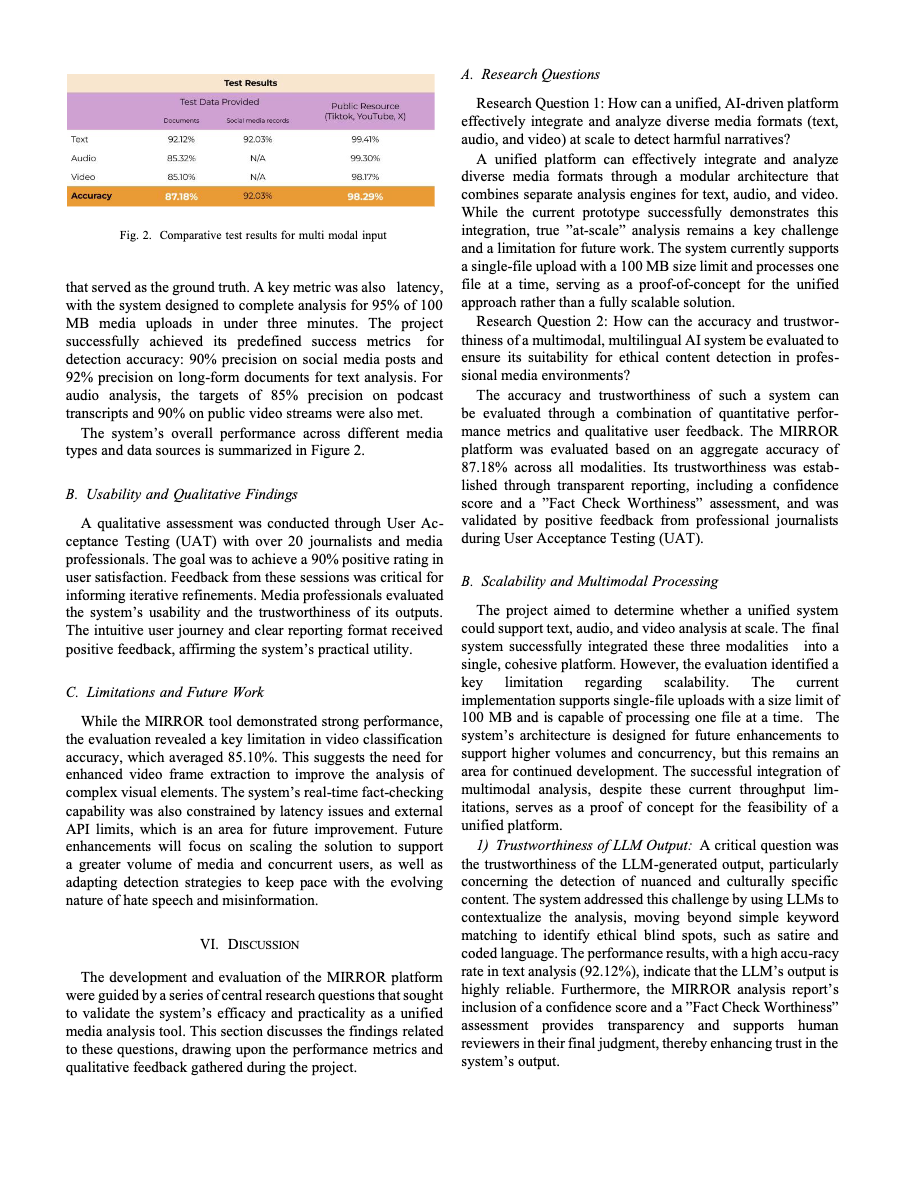
This paper presents MIRROR (Media Integrity Reporting and Review), a multilingual, multimodal AI platform designed to detect misinformation, xenophobic narratives, and harmful content across text, audio, and video media. Built on advanced large language models and multimodal AI technologies, the system integrates fact-checking, content moderation, speech-to-text processing, and video analysis into a unified workflow supporting all six UN official languages.
Evaluation across synthetic and real-world datasets demonstrated strong performance in detecting both explicit and subtle harmful narratives, while user xa with media professionals validated the platform’s usability and trustworthiness. The project highlights the potential of responsible AI to strengthen ethical journalism, media integrity, and accountable digital governance.